Red Sneakers Effect
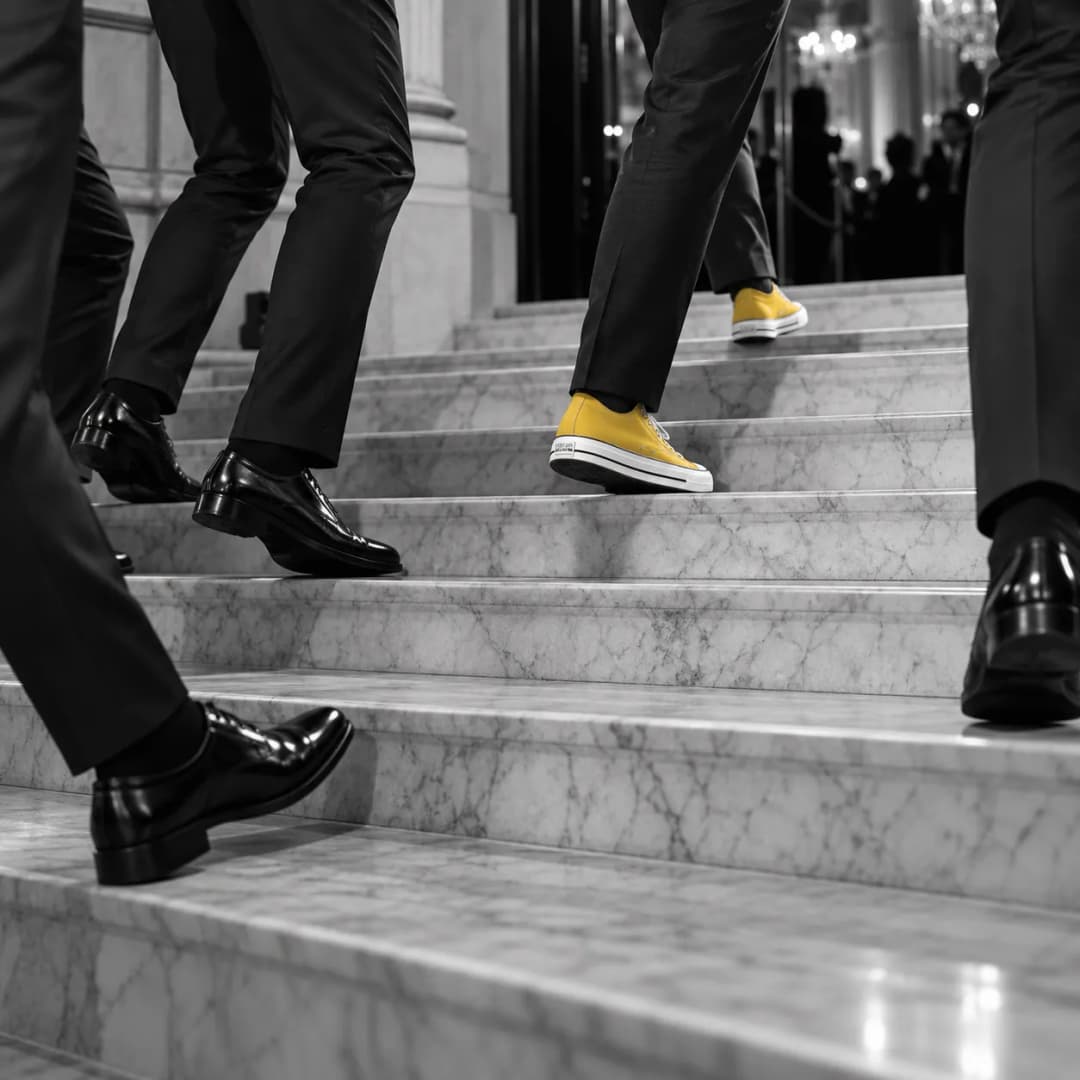
The red sneakers effect is the finding that observers can credit a person who deliberately and visibly breaks a dress code with higher status and competence than a person who follows it. It was named in a 2014 paper in the Journal of Consumer Research by Silvia Bellezza, Francesca Gino and Anat Keinan. The authors identify perceived autonomy as the mechanism and report that the effect disappears in three conditions: when the observer does not know the environment, when the departure looks unintentional, and when there are no shared norms of formal conduct.
What it is
The paper's title states the claim: status and competence can be inferred from signals of nonconformity. The authors treat a nonconforming act as a costly and visible signal, and they describe it as a particular form of conspicuous consumption. Their examples are wearing gym clothes into a luxury boutique and wearing red sneakers in a professional setting. In both, a norm exists, the person is visibly outside it, and the observer has to decide what the departure says.
The idea sits inside the framework of costly signalling, in which a signal is believable in proportion to what it costs to fake. Breaking a dress code carries a risk of disapproval. A person who accepts that risk and carries on can look like someone who is free to choose, and the paper names perceived autonomy as the link between the nonconforming act and the observer's higher ratings. The effect is reported for two inferences together, status and competence, so the observer is judging both what the person has and what the person can do.
The older and louder route to the same inference is conspicuous consumption, where the signal is expensive goods. The red sneakers paper offers a different currency. The cost is social instead of financial, and the audience reads it through its own knowledge of the rule being broken.
The abstract also reports one individual difference. Observers' need for uniqueness, their taste for standing apart from other people, moderated the effect. The abstract does not state the direction of the moderation, so this page does not either.
In effect
The paper's own account of where the effect appears is specific. The positive inferences are reported when observers know the setting, when the nonconformity looks deliberate, and when the setting has shared norms of formal conduct. The University of Chicago Press news release for the paper adds that the comparisons were made mainly in prestigious settings where formal conduct is expected.
The release describes one study in which students ranked the professional status of a professor. The professor was shown either clean-shaven in a business suit or bearded in a T-shirt, and was placed either at a local college or at a top-tier university. Students gave significantly more status and competence to the unshaven professor at the top-tier university. The release reports the authors' view that a person who looks deliberate in breaking a rule can appear to have higher status and a greater sense of competence, and it identifies what makes nonconformity look intentional as the open question.
The release also records two implications the authors draw for brands. Nonconformity can be used in advertising, given demand for clothing and accessories that signal intentional nonconformity, and nonconforming products at premium prices may signal that the wearer can afford the conventional status symbols as well. Both are the authors' suggestions about use. They are not results of a sales test.
A neighbouring finding from the same journal shows how much the audience matters to any status signal. A 2010 paper by Jonah Berger and Morgan Ward reported across four studies that understated branding was more likely to be misjudged by general observers, for example by taking an expensive product for a cheaper one, while consumers with deep knowledge of a product domain preferred the understated cues. That paper sits under inconspicuous consumption. Set beside the red sneakers paper, it shows two signals that carry a message only to observers who know the norm or the category.
What it does not say
The studies measure how observers rate a person. They do not measure whether a brand that borrows the look of the red sneakers effect sells more, and the effect should not be read as a forecast for any product or campaign.
The effect is not a general rule that breaking a rule raises standing. The paper reports that it disappears when the observer is unfamiliar with the environment, when the departure seems unintentional, and when no shared norms of formal conduct exist. A departure that looks accidental, or that no one in the room recognises as a departure, does not produce it.
Nor does the paper say that nonconformity is always rewarded in professional life. It reports a pattern of observer inferences in studies, and it names the question of what makes a departure look deliberate as one the work leaves open. The abstract does not give the number of studies, and the direction in which need for uniqueness shifts the effect is not stated there.
The effect is also not tied to footwear. Red sneakers are one of the paper's examples, alongside gym clothes in a luxury boutique and an unshaven professor in a T-shirt. The name travels more easily than the conditions behind it, and the conditions are the part that decides whether the effect appears.
Sources
- Bellezza, S., Gino, F., & Keinan, A. (2014). The red sneakers effect: Inferring status and competence from signals of nonconformity. Journal of Consumer Research, 41(1), 35-54. https://doi.org/10.1086/674870
- University of Chicago Press Journals (2014). News release on the red sneakers paper. https://www.sciencedaily.com/releases/2014/02/140211094254.htm
- Berger, J., & Ward, M. (2010). Subtle signals of inconspicuous consumption. Journal of Consumer Research, 37(4), 555-569. https://doi.org/10.1086/655445