Hooked
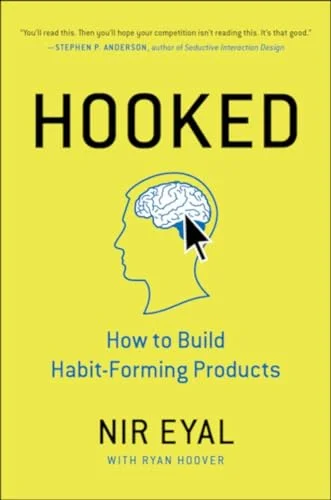
Nir Eyal's 2014 book is the operating manual for habit-forming products: Trigger, Action, Variable Reward, Investment, with worked examples and a workbook. It is the least comfortable book in this collection and the most useful, because it is the only one written for the people doing it rather than about them. Where critics say products are addictive by design, Eyal supplies the mechanism you can actually test.
What it covers
The core claim is that habits are built rather than discovered. External triggers bootstrap a behaviour, and the design goal is to graduate the user onto internal triggers so the product stops having to advertise itself. The strongest internal triggers are negative emotions: boredom, loneliness, indecision, the fear of missing out.
Underneath sits the Fogg Behaviour Model, B = MAT. A behaviour happens only when motivation, ability and a trigger converge at once. Of the two levers a designer holds, ability is the cheaper, so most of the practical advice follows from a single asymmetry: stripping friction beats manufacturing desire.
Variable reward is the engine, and Eyal's contribution is to split it into three. Rewards of the tribe are social validation, rewards of the hunt are resources and information, rewards of the self are mastery and completion. Picking the wrong one is the book's explanation for why most gamification fails.
The investment phase is what separates a feedback loop from a habit. Users who put work in value the product more, stay consistent with their own past behaviour, and rationalise away their doubts. The investment also loads the next trigger, which is what makes the loop a loop rather than a line.
Ethics gets one chapter and a two-by-two.
Main topics
- The Hook Model, the four-stage loop the book is built around.
- Trigger graduation, external cues becoming internal emotional states.
- The Fogg Behaviour Model, and why ability is the cheaper lever.
- Three reward types: tribe, hunt, self.
- The investment phase and stored value, in five forms, content, data, followers, reputation and skill, which is what makes leaving expensive.
- Finite versus infinite variability, Eyal's account of why some products decay and others do not.
- The Manipulation Matrix, his ethics test for product makers.
Concepts drawn from it
- the hook model, the framework itself
- variable rewards and operant conditioning, the engine and its ancestor
- external triggers
- persuasive design, the tradition it belongs to
- behavioral addiction, the endpoint Eyal argues is rare
Reliability
This is a design framework with case-study support, not an experimentally validated theory, and it should be cited as such. The individual components have research behind them, variable reinforcement in particular is about as well established as anything in psychology, but the four-stage loop as a whole has not been tested the way a scientific claim would be. It is a useful model, and useful is not the same as true.
The ethics chapter deserves its own note. The Manipulation Matrix asks two questions, would I use this myself and does it materially improve the user's life, and sorts makers into facilitator, peddler, entertainer and dealer. Both axes are self-assessed, by the maker, about the maker, with no external check, which means the test cannot catch anyone who believes their own pitch. Adam Alter's reporting in *Irresistible*, that some technology leaders limit the use of the products they build at home, is close to a direct empirical test of the first axis, and the test does not favour the matrix.
Eyal's own sequel, *Indistractable*, effectively concedes the point. It argues that regulation and corporate self-restraint will not arrive in time, and hands the burden to the user instead.